
大秦帝国
Chinese-made infrared telescope with domestic detectors achieves astronomical imaging, reducing foreign reliance_我的网站

A | (ECNS) -- A new alliance — the Cattle and Sheep International Sourcing and Sales Alliance — was established on Tuesday under the China (Inner Mongolia) Pilot Free Trade Zone (FTZ), with 21 founding members from Shenzhen, Beijing, Chongqing and the Inner Mongolia Autonomous Region, according to the region's commerce department. Inner Mongolia is a major producer of green agricultural and livestock products in China, with its beef and mutton industry ranking among the region's most distinctive and competitive sectors. Officially inaugurated in Hohhot on April 11, 2026, the China (Inner Mongolia) Pilot Free Trade Zone spans 119.74 square kilometers across three subzones located in Hohhot, Manzhouli and Erenhot. Also on Tuesday, a cold-chain logistics warehouse serving Shenzhen Port was launched in Hohhot. (By Tang Yuxian) 
 。
。
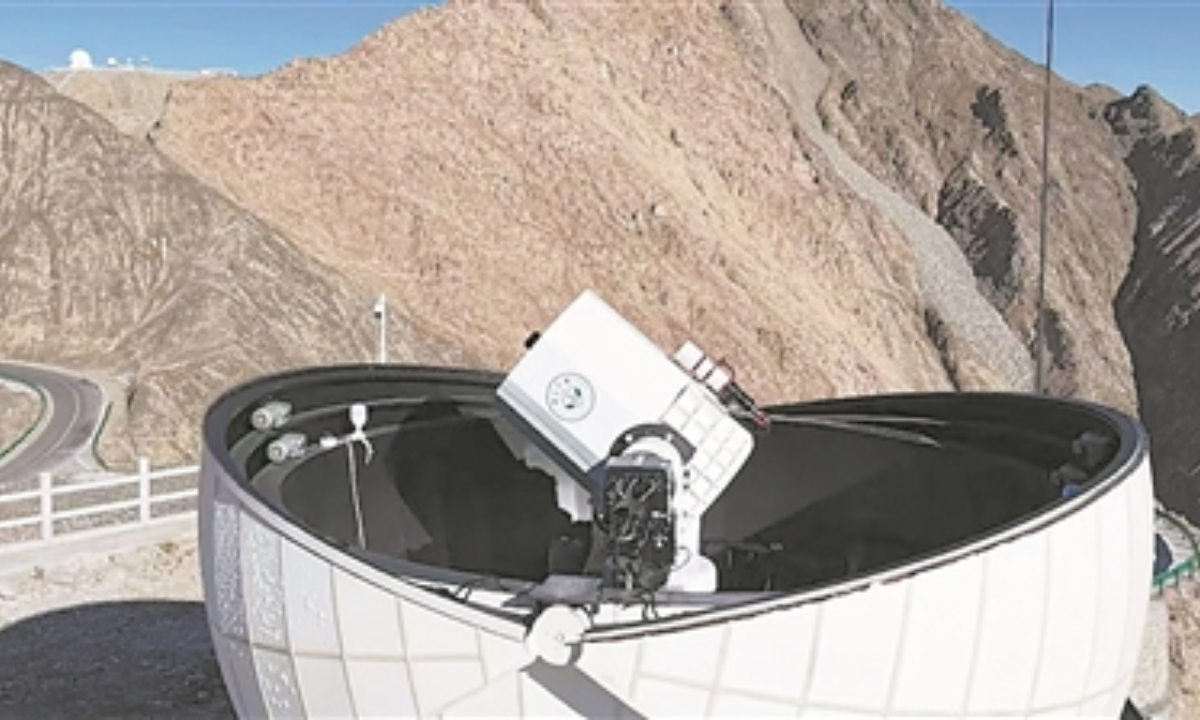
Chinese scientists on Wednesday released the first complete set of observational images captured by China's new-generation ground-based infrared telescope, filling a gap in the country's near-infrared astronomical observation capabilities and reducing reliance on foreign infrared detector technology, China News Service reported on Wednesday.
The 80-centimeter near-infrared telescope was installed at Saishiteng Mountain, Lenghu township, Northwest China's Qinghai Province in October 2024. Jointly developed by Sun Yat-sen University and several partner institutions, the telescope is China's first to achieve scientific imaging in the 1.2-micrometer J band and 2.2-micrometer K band using domestically developed scientific-grade InGaAs and HgCdTe detectors.
The telescope enables unattended remote operations, and can lock onto any target in the sky within 15 seconds. Its infrared capability allows it to see through interstellar dust, enabling it to observe cold and distant celestial objects that are difficult for optical telescopes to capture.
According to Ma Bin, a professor at the School of Physics and Astronomy, Sun Yat-sen University who led the research team that released the infrared telescope's observational images, all three of the telescope's core astronomical observation capabilities were fully validated during operation.
It rapidly responded to and tracked multiple gamma-ray bursts and supernova events, recording the evolution of their infrared afterglows following the explosions. It continuously monitored brown dwarfs, precisely capturing periodic variations in their atmospheric brightness. Using image-stacking technology, it also observed active galaxies billions of light-years away.
Since its deployment in Lenghu, the system has supported infrared observations for more than 10 Chinese research institutions, accumulating valuable experience for the construction of future large-scale infrared telescopes.
Lenghu township, where the world-class astronomical observation base takes shape, is hailed as "the most Mars-like place on the Earth." The astronomical observation base was said to be an astronomical observation site comparable to the top ones in the world by a Nature article published on August 18, 2021, according to the Chinese Academy of Sciences.
Once prospered in 1950s due to its rich petroleum resources, Lenghu is now becoming a premier astronomical observation site and Mars-themed tourist destination, according to Xinhua News Agency.
Global Times
。
Current article:http://tofu.liejuexiaoqundiaopinchuan.pics/list_6k71s/c1n7y5p.html
Published on:13:23:13


